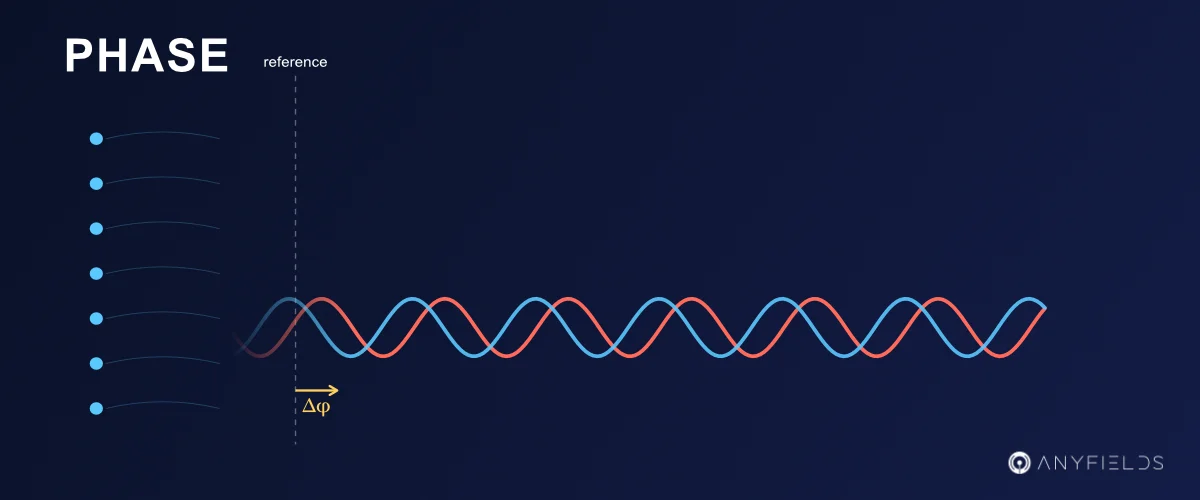
Phase describes where a wave sits in its oscillation cycle. In antenna measurement, phase, together with amplitude, fully defines the electromagnetic field. Without phase data, you cannot reconstruct a radiation pattern, steer a phased array, or diagnose manufacturing defects. Because phase can’t be observed directly, it’s harder and more expensive to measure than amplitude, which is why phase retrieval (recovering phase from amplitude-only data) has become one of the most active research areas in antenna metrology.
When people talk about antenna measurement, most engineers immediately think of gain, radiation pattern, or radiated power. Yet a far less intuitive quantity plays a foundational role: phase.
Invisible and impossible to observe directly, phase is nonetheless essential to understanding how a wave propagates, how multiple waves interact, and how to reconstruct an antenna’s complete radiation.
At Anyfields, phase sits at the center of many measurement challenges — particularly in the development of new rapid antenna characterization techniques.
What is phase? A wave is more than its amplitude
Phase describes the position of a wave within its oscillation cycle — not how strong the wave is, but where it is in time or space relative to a reference.
An electromagnetic wave is a periodic phenomenon. It can be described by several characteristics:
- amplitude
- frequency
- wavelength
- polarization
- phase
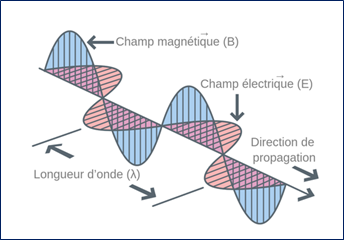
Amplitude indicates the intensity of the electric or magnetic field. Phase describes the wave’s position within its oscillation cycle.
Two waves can share exactly the same amplitude, frequency, and polarization while still being offset in time or space. That offset is a phase difference.
A simple analogy: ocean waves. Two waves of identical height can reach a given point at the same instant, or with a slight delay, that delay is a phase difference.
Why does phase matter? Interference
Phase determines whether waves reinforce each other, cancel out, or redirect radiated energy — this is the physical basis of phased-array beam steering.
When multiple waves meet, they don’t simply add up based on amplitude. Their relative phase determines whether they will:
- reinforce each other (constructive interference);
- partially or fully cancel out (destructive interference);
- change the direction of radiation.
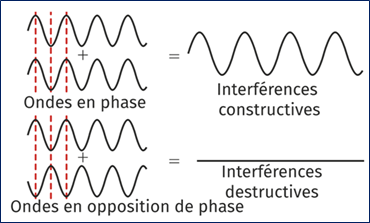
In other words, the complete geometry of an electromagnetic field depends on phase just as much as on amplitude.
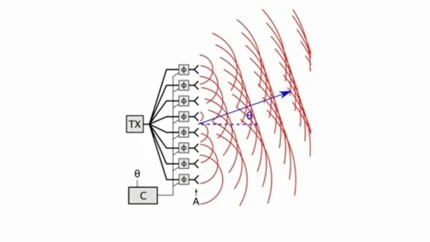
This is the property that lets a phased array electronically steer a beam without physically moving the antennas.
By adjusting only the phase of each radiating element, it becomes possible to steer the beam, create multiple lobes, or cancel interference in specific directions.
What do you actually measure when characterizing an antenna?
Antenna characterization measures the complex electromagnetic field — amplitude and phase together — usually inside an anechoic chamber or on a near-field measurement bench.
Knowing both quantities simultaneously enables you to:
- reconstruct the complete near field;
- calculate the far-field radiation pattern;
- determine gain;
- analyze polarization;
- locate manufacturing defects;
- identify assembly errors;
- perform near-field to far-field (NF-FF) transformations.
In practice, vector network analyzers (VNAs) are widely used because they can measure both quantities directly.
Why is measuring phase so difficult?
Unlike amplitude, phase can’t be observed directly — it’s obtained by comparing the received signal to a perfectly synchronized reference, which demands coherent, highly stable measurement chains.
This constraint requires complex equipment:
- vector network analyzers;
- coherent measurement chains;
- perfectly stable cables;
- highly precise oscillators;
- rigorous calibration procedures.
As frequency increases (millimeter-wave, sub-THz, THz), maintaining this phase coherence becomes increasingly delicate. Mechanical vibration, temperature variation, or minute cable displacement can be enough to degrade measurement accuracy.
These constraints explain a significant share of the cost of modern antenna measurement systems.
Can you measure an antenna without knowing the phase? Phase retrieval
Yes — phase retrieval measures only field amplitude, then uses mathematical algorithms to reconstruct the missing phase, avoiding the need for a coherent reference chain.
This is exactly the question behind a particularly active research field: phase retrieval.
Instead of measuring phase directly, you measure only the amplitude of the electromagnetic field, then use mathematical algorithms to recover the missing phase.
This approach offers several advantages:
- simplified instrumentation;
- reduced cost;
- improved robustness;
- the ability to use sensors that naturally provide only field intensity.
However, this problem is far from trivial.
Why is phase retrieval a hard problem?
Multiple different phase distributions can produce the exact same amplitude map, making the problem mathematically ill-posed — a unique solution isn’t guaranteed without extra constraints.
To recover the correct phase, algorithms must exploit additional information, such as:
- multiple measurement planes;
- physical constraints on the antenna;
- assumptions about the field’s spatial support;
- iterative optimization methods;
- artificial intelligence techniques.
For several years now, phase retrieval methods have been one of the main research directions in antenna measurement, paving the way for measurement systems that are faster, cheaper, and simpler to deploy.
How AI is changing phase retrieval
Convolutional neural networks and other deep-learning architectures can now learn the relationship between amplitude and phase directly from thousands of simulations or measurements — dramatically speeding up reconstruction.
These approaches enable:
- significantly faster reconstructions;
- improved robustness to measurement noise;
- fewer required acquisitions;
- real-time measurement systems.
Even though these methods don’t yet fully replace traditional physical techniques, they represent a major evolution in electromagnetic metrology.
Anyfields' research: phase retrieval via infrared thermography
At Anyfields, we develop new approaches to electromagnetic field measurement based on infrared imaging.
Our sensors directly visualize the spatial distribution of electromagnetic field intensity without using a conventional RF probe. This approach considerably simplifies certain measurements and naturally opens the door to phase retrieval methods. We are working on innovative phase-reconstruction approaches for infrared-thermography-based measurement (paper presented at ICEEA 2025).
By combining innovative sensors, advanced electromagnetic models, and data-processing algorithms, our goal is to make antenna measurement faster, more accessible, and more performant.
Conclusion
Phase is invisible but essential. Without it, you cannot fully describe an electromagnetic field or precisely characterize an antenna.
Phase retrieval is today one of the major challenges in electromagnetic metrology. Progress in numerical methods, optimization, and artificial intelligence is opening unprecedented possibilities for simplifying measurement systems while preserving a high level of precision.
At Anyfields, we believe the combination of new measurement technologies, physical modeling, and artificial intelligence will play a decisive role in the next generation of antenna characterization systems.
FAQ
What is phase in electromagnetism?
Phase describes the position of a periodic wave within its oscillation cycle at a given point in time or space — distinct from amplitude, which describes the wave’s intensity.
Why is phase important in antenna measurement?
Phase, together with amplitude, fully defines the electromagnetic field. It determines interference patterns, enables near-field to far-field transformation, and is required to calculate gain, radiation pattern, and polarization accurately.
Why can't phase be measured directly like amplitude?
Phase has no absolute physical reference by itself — it must be measured relative to a coherent, synchronized signal, which requires stable cabling, precise oscillators, and rigorous calibration.
What is phase retrieval in antenna measurement?
Phase retrieval is a technique that reconstructs the missing phase of an electromagnetic field mathematically, using only amplitude measurements — reducing the cost and complexity of the measurement chain.
Why is phase retrieval considered a difficult (ill-posed) problem?
Because several different phase distributions can produce the exact same amplitude pattern, so recovering the correct one requires extra constraints (multiple scan planes, physical priors, or AI models).
How does artificial intelligence improve phase retrieval?
Deep-learning models (e.g., CNNs) learn the relationship between amplitude and phase from large datasets of simulations or measurements, enabling faster, noise-robust, near real-time reconstruction.