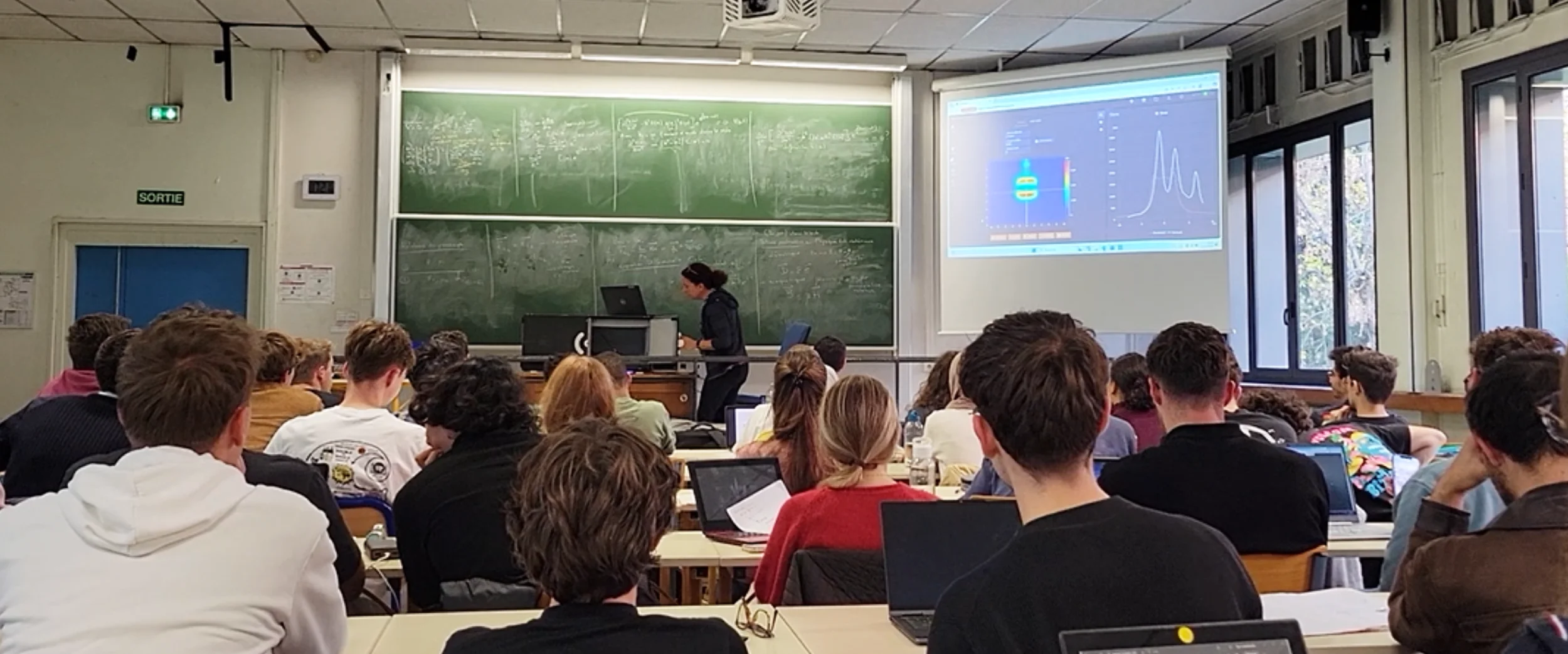
Featuring insights from Nathalie Raveu, Professor at N7 (Toulouse INP) and researcher at the LAPLACE laboratory
Ask any electromagnetism professor what the hardest part of the job is, and you’ll hear some version of the same answer: the subject is invisible. Electric and magnetic fields, radiation patterns, polarization, none of it can be pointed at, touched, or drawn convincingly on a whiteboard. Students are left to imagine equations they can’t connect to anything physical.
We sat down with Nathalie Raveu, who teaches electromagnetism, transmission lines, and antennas to students from bachelor’s through master’s level, to talk about what actually changes in the classroom once you can show the field instead of just describing it. Her answers map onto three challenges that will sound familiar to almost anyone who teaches RF and antenna theory and to each one, a very concrete fix.
Challenge #1 "It's abstract, and the students can't touch it"
The first problem Nathalie named directly: for students, electromagnetic fields are **extremely abstract**. Illustrating phenomena like beamforming or radiation patterns has traditionally meant relying almost entirely on commercial simulation software and even that wasn’t available to first-year students, because the tools were considered too complex for a beginner audience. As a result, only some students ever got a visual anchor for the theory; many simply worked from equations alone, with no way to connect a formula to a physical phenomenon.
Before better tools existed, professors improvised: placing a hand in front of an antenna to physically feel where the field radiated, or moving an arm to see how it disturbed polarization. Nathalie noted that this kind of demonstration was purely qualitative, useful as a gesture, but nothing a student could measure, verify, or build real understanding from. Without a way to actually see the field, electromagnetism stays a subject you calculate but never really witness.
Challenge #2 Anechoic chamber access, and the "here's your data" workaround
The second challenge is more about access and time than about the value of the equipment itself. An anechoic chamber is a fantastic asset when a school has one, it enables precise antenna characterization: radiation diagrams, opening angle, polarization, exactly the kind of rigorous measurement students should be exposed to. But it’s also a resource with real constraints. The procedures are genuinely complex, so students need proper training before they can operate it. Measurements take time, which means working in groups, and a professor needs to be available to supervise throughout. Combined with a shared schedule across a department, chamber time becomes a scarce, carefully allocated resource.
These constraints sometimes push professors toward a practical workaround: qualifying the antenna themselves in the lab, then handing students the finished results to analyze. It’s an understandable way to keep a course moving when time and access are limited, but as Nathalie pointed out, it’s not quite as satisfying from a training standpoint as having students run the measurement themselves. In the meantime, without chamber access, some courses fall back on point-to-point measurements with a spectrum or network analyzer in open space, a setup that makes an accurate link budget harder to obtain.
Challenge #3 Not enough hands-on practice in a subject that's already very mathematical
The third challenge is about practice itself. Students learn electromagnetism better when they get to do it, not just calculate it or watch someone else demonstrate it. Hands-on work makes the subject more tangible, it sparks curiosity, and it gives students a reason to care about equations that otherwise stay abstract on a page. What students are really asking for is the chance to run the full workflow themselves, from design to measurement to analysis, so they can see how each equation connects to the next step in the chain, and ultimately how the whole telecommunications system fits together, from the antenna to the signal it produces.
How EMBox Lab solves these challenges
These three challenges : invisible fields, chamber bottlenecks, and too little hands-on time, all come down to the same root cause: electromagnetism is hard to teach because it’s hard to *see*. This is exactly the gap **EMBox Lab** was built to close.
- “See the invisible”. Students watch an antenna’s beamforming and radiation pattern take shape in real time, turning abstract EM theory into something they can actually see.
- “Learn on your own schedule”. Compact, mobile, and easy to operate, EMBox Lab brings measurement straight into the classroom, no more waiting for anechoic chamber availability.
- “From simulation to real measurement”. Extend the lab beyond simulation: students design, prototype, and physically measure their own antenna, experiencing the full communication chain end to end.

- “Hands-on time for every student”. A 10-second measurement means no queues and no passive observers, every student gets to run their own test.
- “Real data, real engineering”. Students export their measurement data to run their own calculations, gain, HPBW, link budget, connecting theory directly to hands-on analysis.
- “RF made intuitive”. By replacing dense equations with instant visual feedback, EMBox Lab makes electromagnetism approachable, even for beginners with no RF background.
- “Curiosity you can (almost) touch”. Seeing electromagnetic radiation appear on screen makes the subject tangible and makes students want to go further.
Nathalie has already seen the effect firsthand: students who use the EMBox Lab are noticeably more motivated, often doing more than what’s actually assigned, and asking the kind of “how does this even work” questions that can point a student toward an RF or antenna career later on. Enough of her colleagues noticed the same thing that three others on her six-person teaching team asked to bring it into their own courses. Asked to sum up the tool in three words, she landed on: it illustrates the basics of antennas, it demystifies fields that exist but are normally invisible, and it’s genuinely turnkey — from antenna to full datasheet-style specifications, illustrated live.
If your own antenna or transmission-line labs run into the same walls Nathalie Raveu described, discover the EMBox Lab and see what a portable, hands-on measurement lab could bring to your own classroom.