
In brief
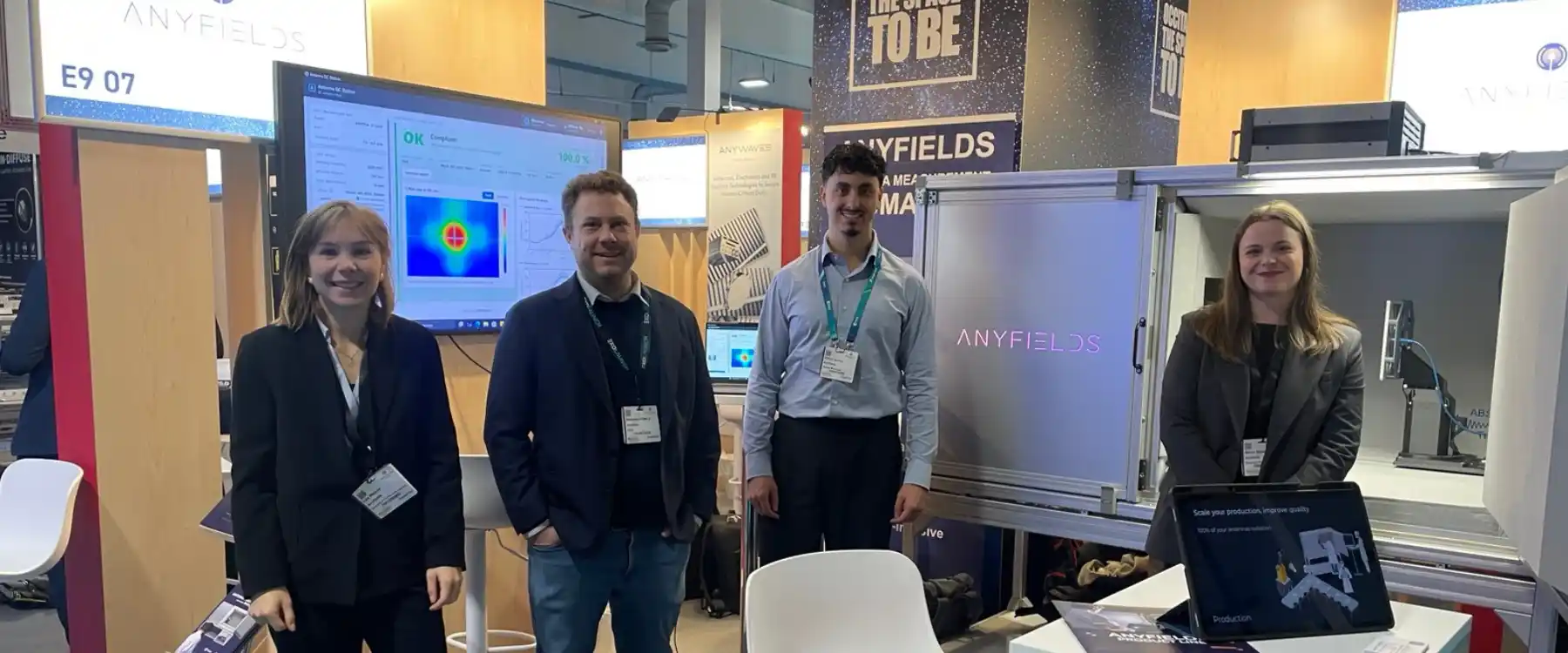
- Anyfields exhibited at Space Tech Expo Europe 2026, in Bremen, Germany, from November 17 to 19, on stand E09 of the Occitanie pavilion (Hall 4).
- Our EMBox XL ran live antenna measurements for three days.
- The most requested demo was our new Go/No-Go mode: a pass/fail check of an antenna against a reference template, in about 10 seconds.
- The show moves to Frankfurt in 2027. We will be there.
Space Tech Expo Europe 2026 brought the space industry to Messe Bremen for three days, and we spent them running live antenna measurements on our stand. The best part was not the stand. It was the people who stopped, listened, and asked the hard questions.
What did Anyfields show at Space Tech Expo Europe 2026?
We brought our EMBox XL and ran live measurements on the floor for the whole show. The EMBox XL is a compact anechoic chamber that measures antenna radiation in about 10 seconds, using infrared thermography.
The antenna under test came from our neighbors at Anteral, a few booths away. Thank you for lending it to us.
Visitors were also welcome to bring their own antenna and watch how it radiates. Seeing people’s faces when the field map appears on screen is still what keeps us going.
How does Go/No-Go antenna testing work?
Go/No-Go is a pass/fail antenna test: each antenna is measured and compared with a reference template in about 10 seconds. The result is simple: compliant or non-compliant. It was the demo most visitors asked to see.
Here is how it works:
- You set a gauge reference that matches your antenna’s specifications.
- Each antenna is measured on the EMBox XL.
- EMSoft, our software, compares the measurement with the reference.
- The operator gets a compliant or non-compliant result.
A dedicated production interface can connect to your own systems through an API.
Why does it matter? In production, antenna testing is often done on a sample basis, because a full measurement takes too long. A 10-second check makes it possible to look at every antenna at the end of the line. It does not replace qualification in an anechoic chamber. It tells you early which antennas need a closer look.
What did visitors ask us most?
Two questions came back again and again:
- “How does it work?” The antenna radiates onto a thin film that heats up according to the field it receives. An infrared camera captures that heat, and EMSoft turns it into a calibrated electric field map. From that map, EMSoft computes the radiation pattern, the gain and the half-power beamwidth.
- “How do you get a result in seconds?” The infrared camera captures up to 300,000 measurement points in a single shot. There is no probe to move point by point, as in a conventional antenna radiation pattern measurement.
Many of you also challenged the method and asked for details. That is exactly what we came for.
What visitors told us on camera
All week, we asked visitors one question on camera: what do you think of our technology? Their answers are in our recap video.
Three themes came back: size, the measurement principle, and use outside the lab.
On size. One visitor compared the EMBox XL with the large facilities usually needed to characterize antennas:
"I think this technology is very impressive. It's very compact. I saw many laboratories, very big, to characterize the antennas, and this one is pretty good."
On the measurement principle. Johannes Königs, PhD, from the Department of Communication Engineering at the University of Bremen, had only worked with conventional setups before:
"It's quite interesting to see how the actual technology works here, with the measurement film, and going through the radiation pattern via the heat of the measurement film."
On field use. Vincent Van Alphen, from Tiat Europe BV, looked beyond the lab:
"Technology looks really great […] and maybe also a possibility for us to use in field."
One more interview, with an engineer who measured his own antenna on the stand, will get its own article soon.
Who came by stand E09 in Bremen?
Customers, prospects, partners and curious visitors kept the stand busy for three days. Among them were teams from Anteral, CNES (including its CEO, François Jacq), Harp Technologies, Phasetrum, and the Montpellier University Space Center (CSUM) with the Van Allen Foundation.
On our side, Manon Bruneau (Product Engineer), Stéphane Gemble (CEO), Sofian Dauriac (Sales Manager) and Léa Wagrez (Marketing & Communication Manager) ran the demos.
We leave Bremen with real conversations to follow up on, and a show that keeps growing with the space industry.
Who made our presence possible?
None of this would have happened without the Occitanie pavilion. Thank you to the Occitanie Region, CCI Occitanie, CCI International Occitanie, AD’OCC and Business France for their support and organization.
Space Tech Expo Europe 2027: where and when?
Space Tech Expo Europe 2027 will take place in Frankfurt, Germany, from November 16 to 18, 2027. The show leaves Bremen for Frankfurt. We will be there.
To those we met on the stand: which question would you like us to answer with a live measurement next time?
FAQ
When and where was Space Tech Expo Europe 2026?
Space Tech Expo Europe 2026 took place from November 17 to 19, 2026, at Messe Bremen, Germany. Anyfields was on stand E09, Hall 4, on the Occitanie pavilion.
Where and when is Space Tech Expo Europe 2027?
Space Tech Expo Europe 2027 will take place in Frankfurt, Germany, from November 16 to 18, 2027.
What is a Go/No-Go antenna test?
A Go/No-Go test compares each antenna with a reference template and returns a pass/fail result. With the EMBox XL and EMSoft, the check takes about 10 seconds per antenna.
Does Go/No-Go replace anechoic chamber testing?
No. Go/No-Go is a fast first check, used for screening and production control. Final qualification still happens in a full anechoic chamber.
Missed us in Bremen? We can show you a Go/No-Go check live, with our team, in an online demo. Tell us about your antenna and we will set it up.