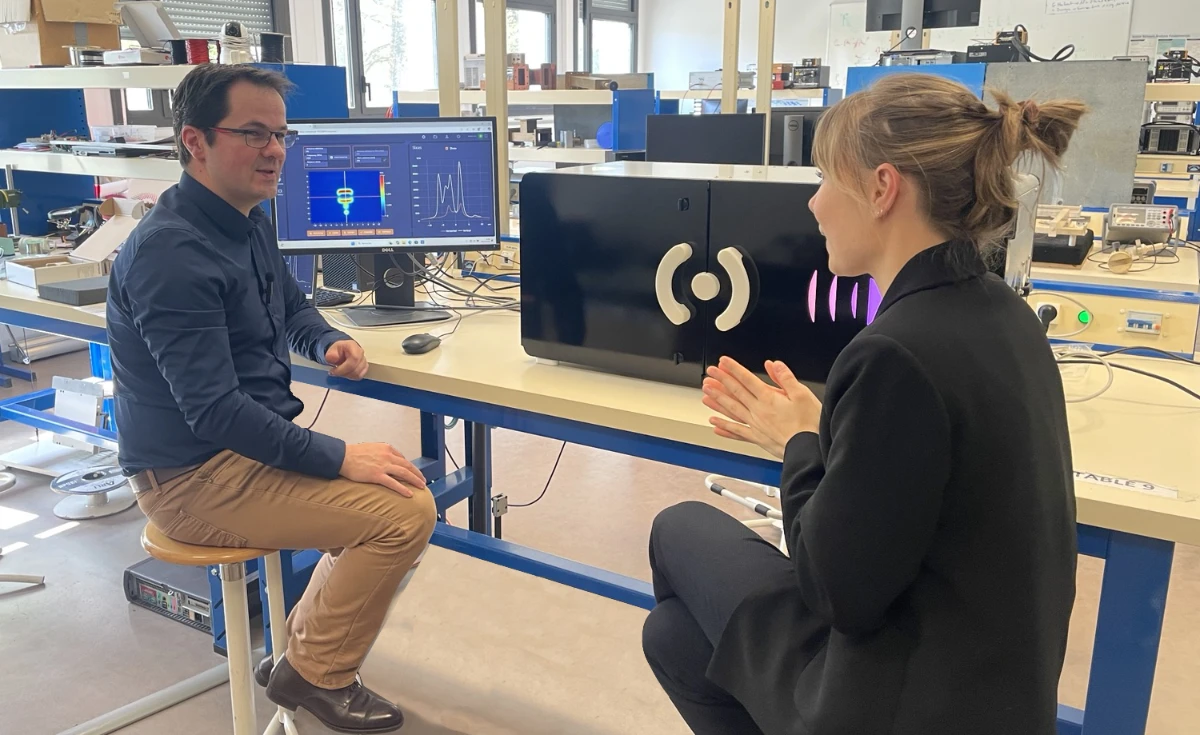
"The EMBox Lab gives students what neither equations nor simulators can offer: seeing the electromagnetic field form, live, on their own antenna."
Cyrille Menudier, Professor & Researcher, XLIM | University of Limoges
Antenna measurement education at University of Limoges: overcoming the invisible barrier
The problem every RF professor knows
Radiofrequency waves are everywhere, in our phones, radars, and satellites. Yet, they remain fundamentally invisible.
This invisibility creates one of the most persistent challenges in teaching electromagnetism: how do you help someone understand what you cannot show?
Cyrille Menudier, a researcher at the XLIM laboratory (University of Limoges) and antenna measurement specialist since 2011, spent years searching for the answer. The discovery of the EMBox Lab opened a new pedagogical path.
"We are stuck as soon as we deal with radiofrequency waves with the students because they are completely invisible. Unlike acoustics or photonics, here, the students see nothing."
Cyrille Menudier, Professor & Researcher, XLIM | University of Limoges
XLIM, a leading laboratory in antenna measurement
The XLIM laboratory (UMR CNRS 7252 / University of Limoges) stands as one of France’s premier research centers for electronics, photonics, and systems. Its RF Systems axis is internationally recognized for its expertise in the modeling, optimization, and experimental characterization of radiating systems.
Through its PLATINOM technology platform, XLIM provides researchers and industrial partners with high-performance electromagnetic characterization tools:
- Diverse measurement facilities: The lab operates seven specialized benches, including anechoic chambers for far-field measurements and motorized near-field scanners.
- Broad frequency coverage: XLIM’s instrumentation allows for the characterization of antennas and S-parameters across a vast spectrum, ranging from 0.5 GHz up to 110 GHz.
- Cutting-Edge research areas: Teams at XLIM work on high-stakes applications such as Satcom-on-the-Move, 5G/6G communications, and UAV (drone) telemetry links.
- Innovation in measurement: Beyond routine testing, the laboratory develops new techniques, such as compressive MIMO beamforming and radar imaging systems based on opto-microwave multiplexing.
In this environment of high scientific rigor, led by experts, the EMBox Lab was evaluated. It is used not to replace these heavy infrastructures, but to bridge the gap between complex simulation and the high-end industrial benches, making electromagnetic visualization immediate and accessible for teaching. The EMBox Lab is a perfect link for the students in Master’s degree to discover the research in electromagnetism and to understand what they can plan if they start a PhD at XLIM laboratory.
Discover the Master’s programs
The EMBox Lab will be integrated into the Master’s degree “Applied Physics and Physical Engineering – PAIP” at the University of Limoges, supervised by Cyrille Menudier and the pedagogical team. This degree offers several tracks:
- ARTICC – Applied Physics & Physical Engineering: A professional-oriented track program covering RF systems, antenna design, and electromagnetic characterization, where the EMBox Lab will serve as a hands-on pedagogical tool in lab sessions.
- EMIMEP – European Master in Intelligent Materials and Electromagnetic Processes: An Erasmus Mundus joint degree bringing together students from across Europe and beyond, with a strong focus on applied electromagnetics and advanced RF technologies.
- HFEP – High Frequency Electronics and Photonics : A training path of the Ceramic & ICT TACTIC Graduate School (EUR TACTIC) where the students will be trained in the fields of high frequency electronics and photonics, through a research-oriented approach with projects and internships in the laboratory, at XLIM or abroad.
Interested in experiencing electromagnetic field visualization firsthand? Explore these programs and join the next generation of RF engineers and researchers.
From abstract theory to tangible fields: the EMBox Lab impact
Bridging the gap between simulation and measurement
In traditional antenna measurement education, students often navigate between two disconnected worlds: numerical simulators (HFSS, CST…) and far-field measurements that provide a final result without showing the physical progression. This transition, from current distribution on the antenna to the radiated field in the far-field zone, is what Cyrille Menudier calls a “blur zone” for students.
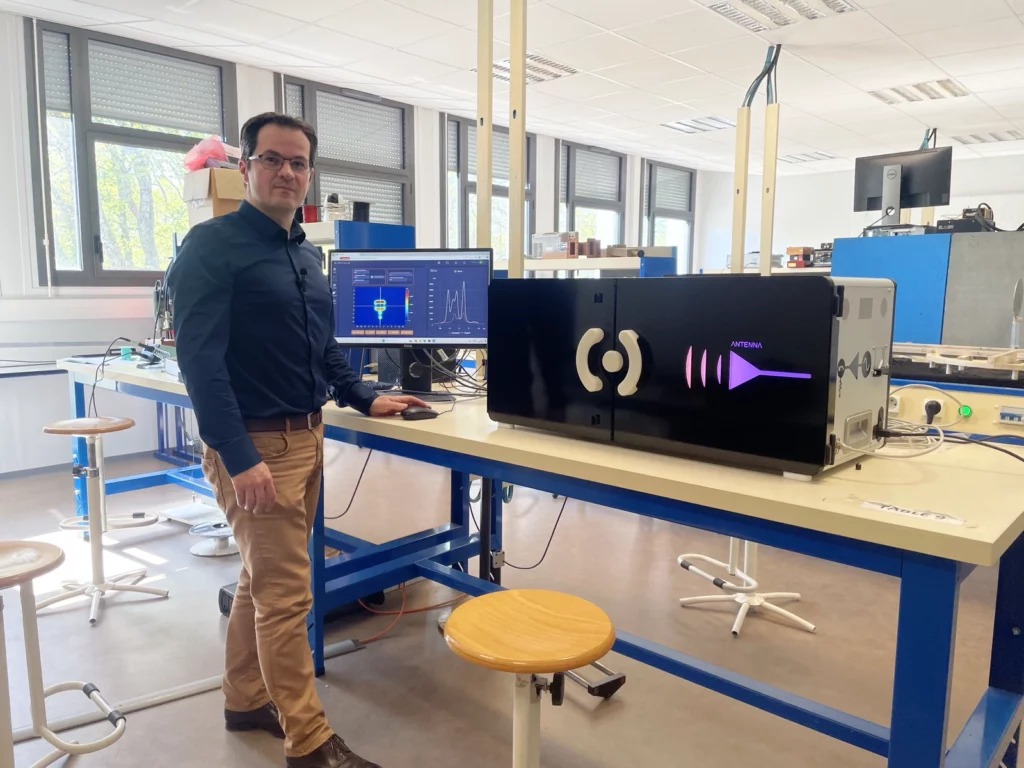
The EMBox Lab fills this gap. "The EMbox Lab is a bridge between the near field and the far field calculation. It allows the student to see what is happening directly, where other tools remain abstract."
Cyrille Menudier, Professor & Researcher, XLIM | University of Limoges
From lab scanner to portable tool
Cyrille Menudier first encountered the EMbox Lab at a previous JNM (Journée Nationale des Microondes) NMW (National Microwave Day). He immediately recognized the principles of professional near-field scanners but in a radically different format.
"It is the counterpart to the near-field scanners we use in antenna measurement, except here it is a compact and portable device. A classic scanner occupies an entire room with absorbers and rail systems... it's reserved for the initiated."
Cyrille Menudier, Professor & Researcher, XLIM | University of Limoges
The pedagogical challenge: capturing the "see it to believe it" generation
Beyond the technical specs, Cyrille Menudier highlights a societal shift in scientific education. Traditional methods, starting with equations to reach applications, no longer resonate with today’s students.
The solution? Inverse Pedagogy. Start with the concrete, a radar or a satellite link, to spark curiosity. The EMBox Lab provides the “illustrative brick” that Cyrille Menudier considers essential in modern electromagnetism teaching.
Why the EMBox Lab? Key deciding factors
- Scientific reliability: In a research lab like XLIM, scientific credibility is non-negotiable. The data produced is qualitative enough for Master’s level academic use, allowing students to work with real physical values and raw data exports.
- Compactness and portability: Equipped with handles, it can be moved from a lab room to a lecture hall or even a trade show.
- Operational time savings: While a traditional scanner might take 5 to 10 minutes per configuration, the EMBox Lab provides results in seconds.
Implementation at University of Limoges: four concrete use cases
The EMBox Lab will be integrated into the Applied Physics / Physics Engineering Master’s program at the University of Limoges.
- Calculation / Simulation / EMBox Lab combination: Students design, simulate, manufacture, and characterize their antennas with direct field visualization.
- Printed antenna measurement Lab: In-depth study of the transition from the electric field to the radiation pattern using data exports.
- Lecture support: Live illustrations of theoretical aspects to anchor equations in reality.
- Scientific outreach: Used at trade shows and open houses to make electromagnetic waves tangible for undergraduated students or future students.
Advanced use case: Cyrille Menudier plans to introduce defective antennas into lab sessions so students can identify anomalies in the field themselves, a “pedagogy of error” made possible by real-time visualization.
In conclusion: three words, one vision
“Fast, visual, portable.” Cyrille Menudier’s definition of the EMBox Lab.
For Cyrille Menudier and the pedagogical team, the EMBox Lab is not a substitute. It is a transitional tool, one that bridges the gap between the abstraction of equations and the physical reality of electromagnetic fields. A bridge between what we calculate and what we measure. A first step if the students decide to pursue a PhD at XLIM.
The EMBox Lab will be rolled out in courses starting in September 2026, first in Master’s-level lab sessions, then as part of supervised projects on antenna measurement and the complete telecommunications chain.
About the EMBox Lab
The EMbox Lab is a compact antenna measurement system designed specifically for education. It enables the visualization of electromagnetic fields using patented infrared technology. Unlike traditional methods, it allows for direct field acquisition without the need for point-by-point scanning, and includes features for exporting measurement data for quantitative analysis.
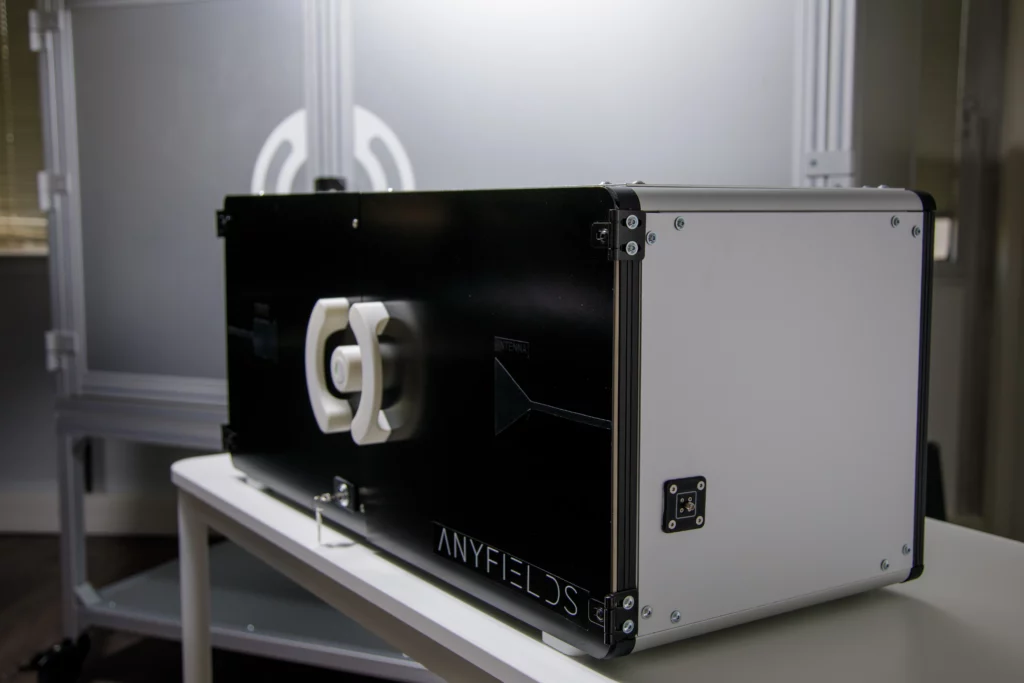

Cyrille Menudier
Professor & Researcher, XLIM | University of Limoges